The short answer
Photograph the Pyramids of Giza early or late in the day, from the Panorama area for all three in one frame and from the Sphinx enclosure for the Sphinx against the pyramids. Leave the drone at home, because Egypt bans drones without Ministry of Defence permission, and check the official rules before you bring a tripod or lights.
Good pictures of the Giza plateau take planning. This guide covers the site, the classic views, light and heat through the year, and the rules on drones, tripods and people. For finished images you can use freely, the Egypt topic page holds six CC0 photos by Norik Uka, including the Great Sphinx in profile and the pyramids in desert haze.
What is at the Giza Necropolis?
The Giza Necropolis holds three royal pyramids, built for the 4th Dynasty kings Khufu, Khafre and Menkaure, plus the Great Sphinx and many smaller tombs and temples. It is part of the UNESCO World Heritage site “Memphis and its Necropolis, the Pyramid Fields from Giza to Dahshur”, inscribed in 1979.
According to Egypt’s Ministry of Tourism and Antiquities, the Great Pyramid was built for Khufu, and the other two for Khafre and Menkaure, his son and grandson. Khufu’s pyramid is the oldest and the largest of the three. UNESCO describes it as the only surviving wonder of the ancient world. Each pyramid was one part of a larger complex with smaller pyramids, tombs, boat burials and a pair of temples joined by a causeway.
The Great Sphinx is carved from the bedrock and sits in its own ditch, fronted by the Sphinx Temple and the Khafre Valley Temple. Ancient Egypt Research Associates (AERA), who mapped it stone by stone, conclude that Khafre most likely created most of it. For a photographer, the single most useful fact about it is simpler: the Sphinx faces east, so it meets the morning sun.
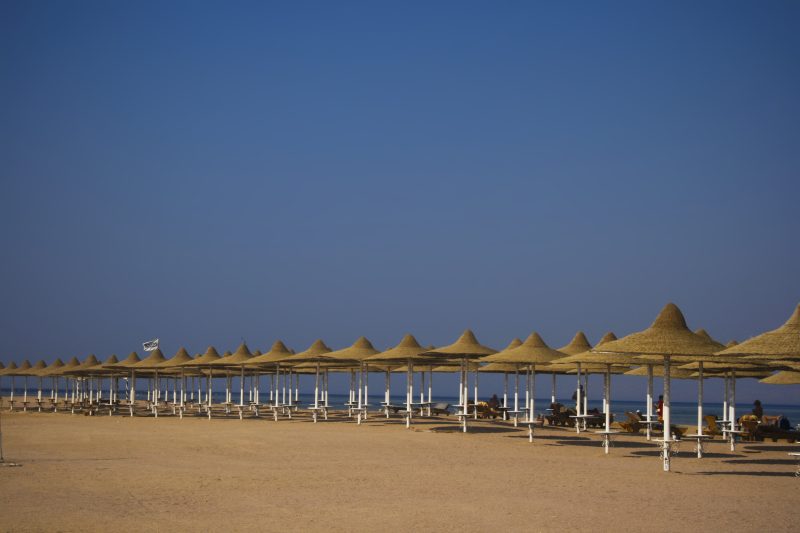 Rows of Straw Umbrellas on an Egyptian Beach by Norik Uka
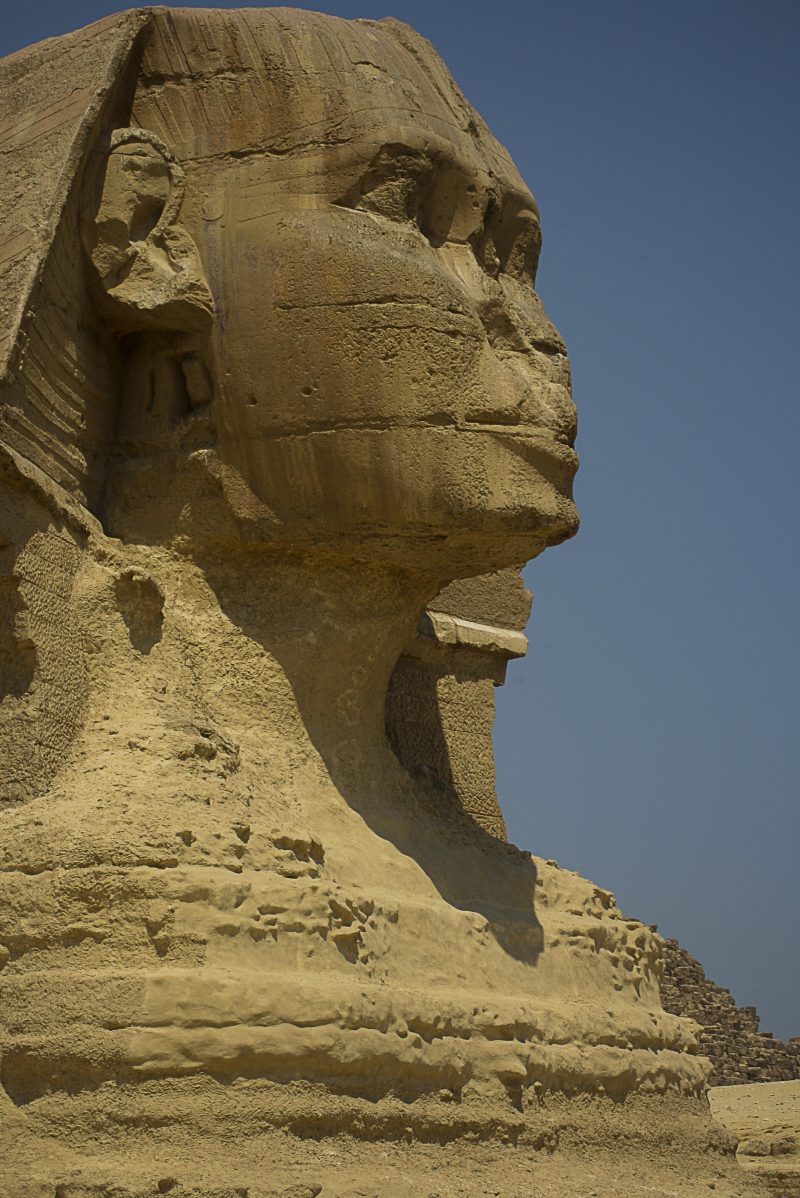 Profile of the Great Sphinx of Giza by Norik Uka
 Great Sphinx in Front of a Pyramid at Giza by Norik Uka
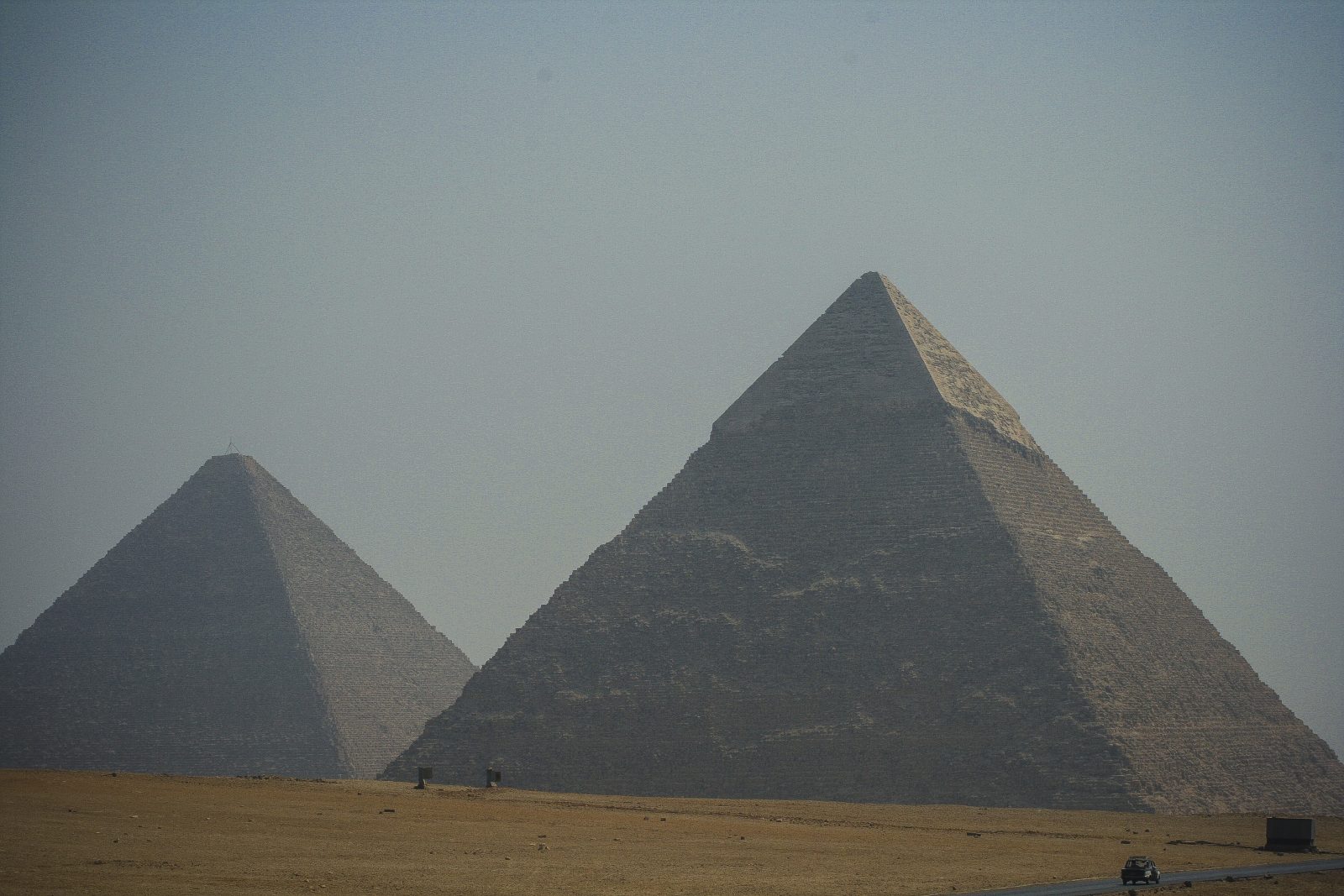
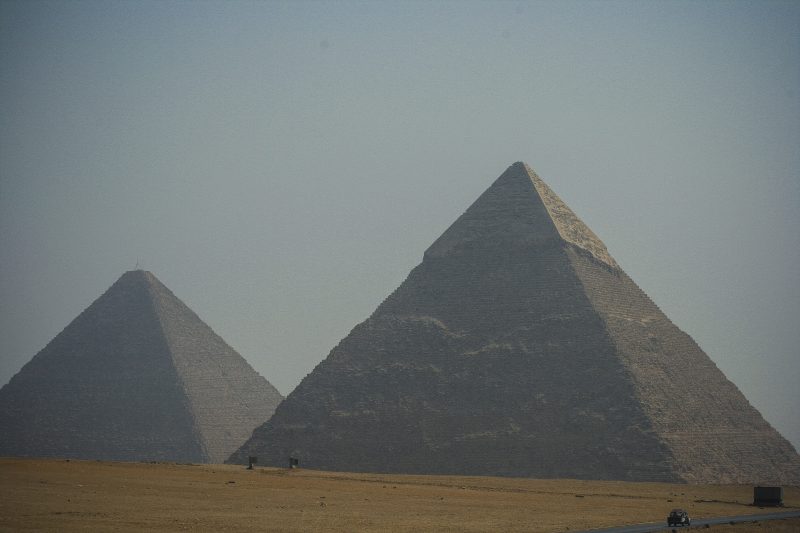 Pyramids of Giza in the Desert Haze by Norik Uka
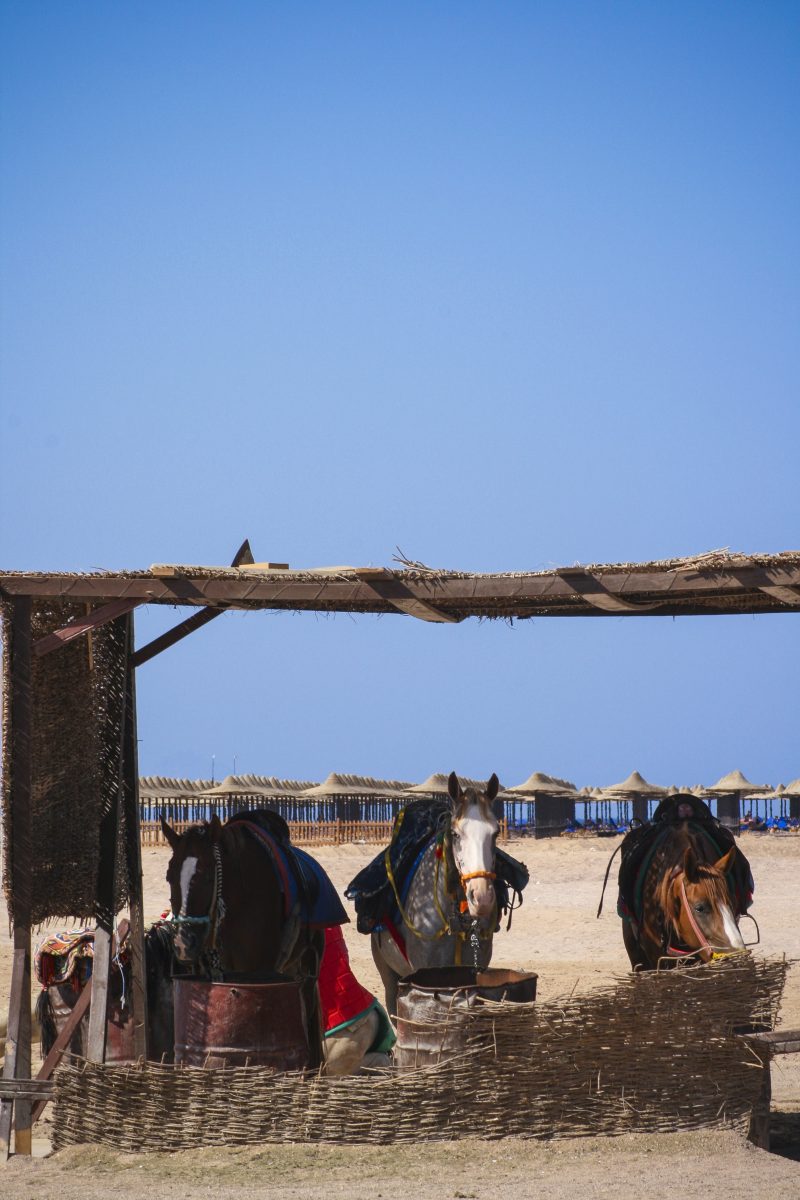 Horses Resting in a Shaded Stable in Egypt by Norik Uka
 Domed Building Silhouette at a Golden Egyptian Sunset by Norik Uka
Where is the best place to photograph the pyramids?
The best place to photograph all three pyramids together is the Panorama area on the plateau, a stop that overlooks the pyramids and is served by the site’s electric buses. For the Sphinx, the area in front of it by the valley temple gives the classic view, with the pyramids rising behind.
The plateau has changed in recent years. Egypt’s State Information Service reported in April 2025 on a new visitor center, a site gate on the Cairo-Fayoum road, and an electric shuttle bus system. Private cars and tour buses no longer drive onto the plateau, so plan your shoot around the bus stops.
| Viewpoint | What you get | Best light |
|---|---|---|
| Panorama area | All three pyramids in one frame, with the desert around them | Early morning or late afternoon, when low sun separates the pyramid faces |
| Sphinx enclosure and Khafre Valley Temple | The Sphinx in profile or head-on, with a pyramid behind it; the temple masonry as foreground | Morning, because the Sphinx faces east and the sun lights its face |
| Bases of the pyramids | Scale: single blocks, people for size, steep upward angles | Side light, morning or afternoon, for stone texture |
| Edge of town, around Nazlet El Semman | The pyramids with the modern city in the frame, ancient and modern side by side | Late afternoon and dusk, when city lights start to come on |
Positions shift as the site develops, so check the current map at the visitor center. A sun-position app shows where the sun will sit relative to each viewpoint on your date.
How do I get a good Sphinx photo?
For a strong Sphinx photo, go early, when the eastern light falls on the face, and use the line of the body to lead the eye toward a pyramid behind it. A side view shows the long lion body; a front view puts the face first. Both work best before the crowds build.
The profile view is the one in the Largephotos collection. A standard zoom covers most framing, and a longer lens compresses the distance between the Sphinx and the pyramid behind it, so the pyramid looks closer and larger. Keep the horizon level: the pyramid edges are strong diagonals, and a tilted frame shows at once.
What is the best time to visit the Giza pyramids for photos?
The best time to visit the Giza pyramids for photos is the cooler half of the year, roughly November to March, and the first hours after the site opens. Summer afternoons are hot and the light is flat and hard. Spring can bring sand and dust storms that cut visibility.
The World Meteorological Organization’s averages for Cairo (1981 to 2010) give a clear picture of the heat you will work in:
| Month | Average daily high | What it means for a shoot |
|---|---|---|
| January | 66°F (19°C) | Comfortable all day; soft winter light |
| April | 83°F (28°C) | Warming; spring dust storms are possible |
| July | 95°F (35°C) | Shoot early, carry water, rest in shade at midday |
| October | 86°F (30°C) | Still warm; mornings are the working window |
| December | 69°F (20°C) | Comfortable; short days, so plan around the light |
Rain is close to zero from June to September and light the rest of the year, so expect clear skies and let the light angle do the work. The Ministry has reported adding sun shades, benches and charging points for phones and cameras on the plateau.
Can you photograph sunrise at Giza?
That depends on the opening time on the day you visit, which the Ministry sets and can change, so check it on the official site first. If the gates open after sunrise, the first hour still gives low, warm light on the eastern faces and the Sphinx.
How do I deal with haze and dust?
Haze and dust are part of photographing Giza, so plan for them: shoot with the sun to the side or behind you, use a lens hood, and protect the camera when you change lenses. The site sits at the edge of the desert next to a large city, and both add particles to the air.
Haze lowers contrast, most of all toward the sun. The collection’s desert-haze photo shows that it can still work: let the pyramids sit as soft shapes and expose for the sky. For crisp detail, keep the sun to your side and raise contrast gently in editing.
Dust is the bigger risk to equipment. Change lenses with the camera pointing down and your back to the wind, and keep a blower and cloth in a sealed bag. The Government of Canada notes that sand and dust storms can occur in spring and can cause poor visibility and breathing problems; if one arrives, stop shooting and get indoors.
Can you fly a drone in Egypt?
No, not without prior permission from the Egyptian Ministry of Defence. The UK government says you must not import, use or produce drones in Egypt without that permission, and that doing so can bring a prison sentence of up to 7 years or a fine of 5,000 to 50,000 Egyptian pounds.
The Government of Canada describes drones as strictly prohibited and warns that unauthorized use may carry charges similar to espionage. Do not pack a drone for Giza; for height, use the high ground on the plateau.
Can I bring a tripod or professional camera to Giza?
Ordinary cameras are expected at Giza, but professional equipment needs a permit to enter Egypt, and we found no official rule on tripods at the plateau itself. Before you pack a tripod, check the visitor rules of the Ministry of Tourism and Antiquities at egymonuments.gov.eg or ask at the ticket office.
The UK government says a permit is required to enter Egypt with professional photography or film equipment, including photography umbrellas, artificial outdoor lighting and any equipment that occupies or blocks public roads. The Government of Canada adds that officials may confiscate large video cameras, filming equipment and binoculars on entry if you did not get approval in advance. For a commercial shoot, arrange permits through official channels first.
| Item | What the official sources say |
|---|---|
| Drone | Not without prior Ministry of Defence permission; heavy penalties (UK and Canadian advisories) |
| Professional photo or film gear, lighting, umbrellas | Permit needed to bring it into Egypt (UK advisory) |
| Tripod on the plateau | No official rule found; check egymonuments.gov.eg or the ticket office |
| Photographing Egyptian citizens | Written permission required under Ministry of Tourism regulations; children may not be photographed (UK advisory) |
| Tripod, flash, selfie stick at the Grand Egyptian Museum | Not permitted (museum’s official ticketing site) |
How do I photograph people and handle touts respectfully?
Ask before you photograph anyone, never photograph children, and say a clear, polite “no, thank you” to offers you do not want. The UK government reports that Ministry of Tourism regulations require an Egyptian citizen’s written permission before you take their photo, and that photographing children is prohibited.
The same advice says not to photograph officials without consent, that photographing near military property is illegal, and that so is taking or sharing photos seen as damaging to the country’s image. Frame the monuments and keep strangers out of the shot.
The UK government also advises caution in tourist areas, where scammers and touts sometimes target foreign visitors. A friendly, firm refusal and walking on is the polite answer. Agree on any price before you accept a ride or a photo with an animal, not afterward. If something goes wrong, the tourist police number in Egypt is 126.
One more point for later: CC0 waives copyright, but it does not clear the rights of people shown in a photo. Our license page explains how this works on Largephotos.
Is the Grand Egyptian Museum worth adding to a Giza shoot?
Yes, if you have a spare half day: the Grand Egyptian Museum in Giza is open, and personal photography with phones and cameras is allowed in most areas. It opened officially in November 2025, and its galleries include the Tutankhamun Galleries, the Grand Hall, the Grand Stairs and Khufu’s Boats Museum.
Its official ticketing site lists the rules. Tripods, monopods, selfie sticks, drones, external lighting and live-streaming equipment are prohibited, and flash is not permitted. Photography is restricted in designated areas of the Tutankhamun Galleries, and visitors should not photograph other visitors or staff without consent. Commercial photography needs written approval, and tickets should be bought through the official site.
See all 45 free Landscapes photos
How should I plan a photo shoot at Giza?
Plan a Giza shoot backward from the light: pick the viewpoints, check the sun and the official opening hours, pack light and within the rules, and arrive as the gates open. Most problems at Giza come from heat, dust and banned gear, and all three can be handled before you leave the hotel. The steps below put it in order.
- Choose your shots. Decide which views matter most: all three pyramids from the Panorama area, the Sphinx from the side or front, or close-ups at the pyramid bases.
- Pick the season and the day. Choose the cooler months if you can, and check the forecast for dust.
- Check official hours and rules. Look up current opening hours, tickets and equipment rules at egymonuments.gov.eg, and the latest advisory from your own government.
- Map the sun. Use a sun-position app for your date, and remember that the Sphinx faces east.
- Pack within the rules. No drone. Bring a lens hood, a blower, cloths, spare batteries and water. Leave lighting kits at home unless you hold a permit.
- Arrive early. Ride the electric buses between stops and shoot the most light-sensitive view first.
- Ask before photographing people. Keep strangers out of the frame or get permission, and never photograph children.
- Back up the same day. Copy your files each evening.
To share your Giza work, see how to join as a photographer, or browse the phone and professional collections.
Questions people ask
Where is the best place to photograph the pyramids of Giza?
The Panorama area, which overlooks the pyramids, is the natural place to try for all three in one frame. For the Sphinx with a pyramid behind it, use the area in front of the Sphinx by the Khafre Valley Temple.
Can you fly a drone at the pyramids?
No. Egypt does not allow drones to be imported or used without prior Ministry of Defence permission, and penalties include prison.
Are tripods allowed at Giza?
We could not find an official rule for tripods on the plateau, so check egymonuments.gov.eg or ask at the ticket office before you go. Tripods are not allowed inside the Grand Egyptian Museum.
What is the best time of day to photograph the Sphinx?
Morning is best, because the Sphinx faces east and the early sun lights its face.
Can I photograph local people at the pyramids?
Only with permission. The UK government reports that Ministry of Tourism regulations require an Egyptian citizen’s written permission before you photograph them, and photographing children is prohibited.
How this guide was written: the Largephotos team checked each fact against the official and primary sources listed above, checked on 7 October 2026. Prices and opening hours change, so we do not quote them. Spotted an error? Write to admin@largephotos.net.